
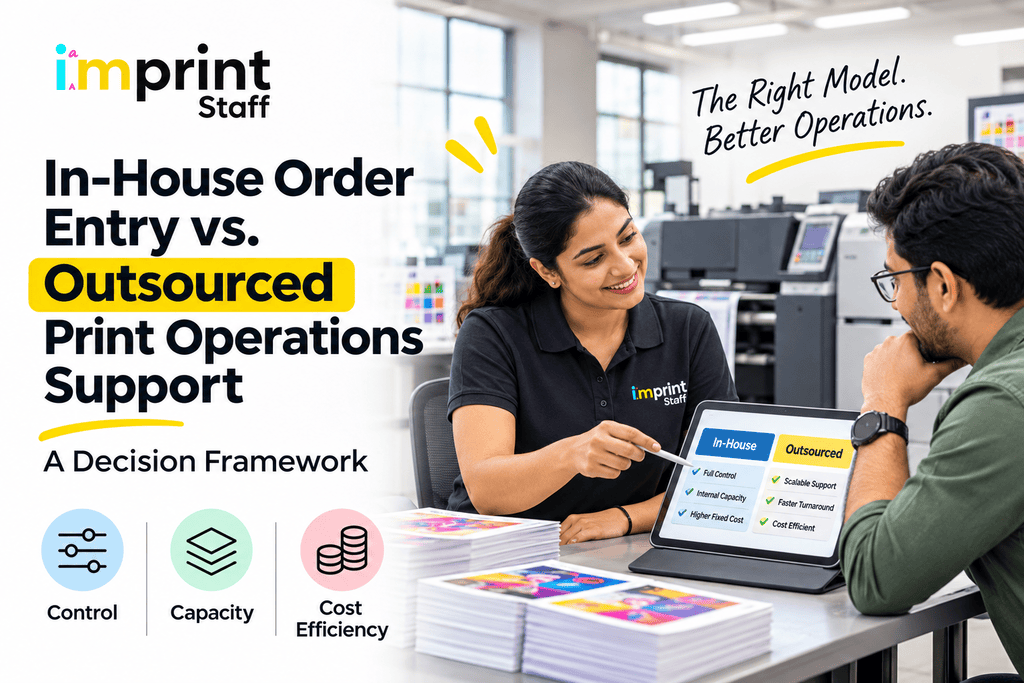

Keep order entry and estimating in-house when the work needs someone physically in your shop, volume is low or unpredictable, or you can hire and train an experienced person quickly. Outsource it when the work happens entirely inside your MIS and email, volume is steady, and you need print-experienced help faster or more flexibly than local hiring allows. Software helps in both cases, but it doesn’t replace the person who handles the exceptions.
Most shops reach this decision the same way: the owner or production manager has been entering orders and building estimates between everything else, the backlog keeps growing, and pricing has started to drift from job to job. The question isn’t whether you need help. It’s which kind.
This guide gives you a six-factor scorecard, a full cost comparison, a fit guide by shop profile and the questions to ask before you commit either way.
First, a Quick Clarification: This Isn’t Managed Print Services
If you’ve searched “print management outsourcing,” you’ve probably seen results about managed print services: companies that manage an office’s printers and copiers, or that handle a business’s printing jobs. That’s a different industry.
This article is about print operations support for businesses that sell print, such as commercial printers, sign shops, promotional products distributors and apparel decorators. “Outsourcing” here means staffing your internal order-to-production workflow (order entry, estimating, vendor coordination and queue management) with outside help, not sending your printing to someone else.
The Real Options: Status Quo, Local Hire, Software, or Outsourced Support
Most shops are choosing between four paths, often in combination:
| Option | What it means | What it solves | What it doesn’t |
|---|---|---|---|
| Status quo (owner or production manager does it) | Order entry and estimating fit around everything else | No new cost on paper | Caps the owner’s time for sales; estimates get inconsistent; backlog grows with volume |
| Local in-house hire | A dedicated employee on-site | Full-time presence; can handle on-site tasks too | Slow to fill; print experience is hard to find; carries full employment cost and turnover risk |
| Print shop management software | MIS, web-to-print or workflow automation | Consistency, fewer manual steps, client self-service | Doesn’t make judgment calls; still needs someone to run it and handle exceptions |
| Outsourced print operations support | A dedicated, print-experienced remote team member working in your systems | Fast added capacity; industry knowledge from day one; scales with volume | Can’t do physical on-site tasks; needs documented processes and system access |
The status quo is a real option, but it isn’t free. Its cost shows up as the owner’s lost selling time, slower quotes and margin that leaks through inconsistent pricing.
The Six-Factor Decision Scorecard
Score each factor for your shop. If most of your answers fall in the right-hand column, outsourcing is likely the better fit. If most fall in the left, hire locally. A mix usually means a hybrid.
| Factor | Points toward in-house | Points toward outsourced |
|---|---|---|
| 1. Physical presence | Role includes receiving, samples, customer pickups, floor coordination | Work happens entirely in your MIS, email and file systems |
| 2. Volume pattern | Low, irregular volume; part-time need | Steady volume, with seasonal or rush peaks that need flexibility |
| 3. Hiring market | You can find experienced print order entry or estimating staff locally, quickly | Local candidates are scarce, or you’d have to train a generalist from zero |
| 4. Complexity and judgment | Jobs depend on tacit knowledge that only exists in someone’s head and isn’t documented | Your pricing logic and order process can be documented and taught |
| 5. Speed to capacity | You can wait through a hiring and training cycle | You need help in weeks, not months |
| 6. Cost structure | You prefer a fixed employee and can carry full employment overhead | You want lower fixed overhead and the ability to scale hours or headcount |
Factor 1: Does the role need someone physically in the shop?
This is the clearest dividing line. If the person you’re picturing will also check in deliveries, pull samples, walk jobs to the floor or meet clients at the counter, you need someone on-site, at least for that part of the role.
Order entry and estimating themselves rarely require it. They happen in your MIS, your inbox and your file system. A common setup is a local person for floor and counter tasks, with order entry and estimating handled by dedicated remote staff.
Factor 2: What does your volume look like?
A dedicated hire, local or outsourced, makes sense when there’s enough steady work to keep one person productive. If you only need ten hours a week, a full-time hire is overkill and a part-time or software-first approach may fit better.
Seasonality matters too. Sign shops ahead of spring events, apparel decorators in back-to-school and holiday seasons, and promo distributors in Q4 all see peaks. Local hiring is slow to flex; outsourced capacity is usually easier to scale up and back.
Factor 3: Can you actually hire for this locally?
Many shops can’t find people who already understand run charges, substrates, finishing and print MIS workflows. Hiring a generalist means training them on the industry and your shop, which takes months and ties up the person who’s already overloaded. If experienced candidates are available locally, that shifts the decision toward in-house.
Factor 4: Is the work documented, or does it live in someone’s head?
Outsourcing works best when you can explain how you price jobs and process orders. If your estimating logic exists only in the owner’s memory, any new person, local or remote, will struggle until it’s written down. Documenting it is worth doing either way: it protects margin and reduces dependence on one person.
Factor 5: How fast do you need relief?
Local hiring means posting, screening, interviewing, notice periods and then training. Outsourcing to a print-experienced provider skips most of the screening and much of the industry training. If the backlog is costing you jobs now, speed matters.
Factor 6: What cost structure fits your business?
The next section breaks this down. The short version: a local hire costs much more than the salary, and outsourcing converts much of that fixed overhead into a scoped cost tied to the work.
What’s the Real Cost Difference Between Hiring Locally and Outsourcing?
The fair comparison isn’t salary vs. outsourcing fee. It’s the fully loaded cost of each. For context, the U.S. Bureau of Labor Statistics reported that benefits made up 30% of private-industry employer compensation costs in June 2026, so the cost of an employee runs well above their wage before you count hiring and training.
Use this checklist to compare your own numbers:
| Cost line | Local in-house hire | Outsourced print operations support |
|---|---|---|
| Wages | Yes | Included in the provider’s rate |
| Benefits, payroll taxes, insurance | Yes (BLS average: 30% of total compensation) | Typically handled by the provider |
| Recruiting (job ads, agency fees, interview time) | Yes | Largely handled by the provider |
| Training time (yours and theirs) | Industry training + your processes | Mainly your processes, if the staff are print-experienced |
| Equipment, workspace, software seats | Yes | Software seats in your systems; workspace and equipment typically on the provider |
| Management time | Yes | Yes (similar daily direction) |
| Coverage for sick days, leave, turnover | Gaps or overtime; re-hiring if they leave | Ask the provider about backup cover and replacement |
| Cost of errors and slow quotes | Depends on experience | Depends on experience |
Two costs are easy to miss:
- The owner’s time. If you or your production manager spend, say, 15 hours a week on order entry and estimates, that’s time not spent selling, managing quality or growing key accounts. Put a value on it before calling the status quo “free.”
- Margin leakage. When estimates depend on whoever’s free, pricing drifts. Inconsistent quoting is hard to see in a single job, but it shows up in job costing over a quarter. (If you don’t currently track profit by job, our finance and accounting support for print businesses covers the bookkeeping side of that.)
Where Print Shop Management Software Fits
Print shop management software (a print MIS, web-to-print storefronts and workflow automation) is often presented as the alternative to hiring. In practice, it’s a complement to either choice.
Software does well at: standardizing pricing logic, reducing re-keying, giving clients self-service ordering and status, and automating routine notifications.
Software doesn’t: decide how to price an unusual job, notice that a client’s spec doesn’t match the file, chase a vendor about a late substrate, or decide which rush job goes first. Someone has to run the system and handle the exceptions, and that person is your in-house hire or your outsourced team.
The best results usually come from good software operated by people who understand print. If you’re buying software, plan who will own it. If you’re hiring or outsourcing, make sure that person can work inside your existing system.
Can Outsourced Staff Work Inside Our Existing MIS/ERP System?
Yes. That’s how dedicated print operations support should work. An outsourced team member gets their own login to your MIS/ERP, email and file systems and works the way an in-house employee would. You shouldn’t have to change platforms or route orders through a separate tool.
Ask any provider to confirm system access before you start, and make sure each person has an individual login you can revoke. If a provider wants you to email them orders so they can re-enter them elsewhere, that’s a red flag; it doubles the work and creates a second source of truth.
What Size Print Shop Is a Good Fit for Outsourcing vs. a Local Hire?
Shop size matters less than the shape of the work. These profiles are typical:
| Shop profile | Usually fits | Why |
|---|---|---|
| Small shop, owner does everything, volume growing | Outsourced support for order entry first, then estimating | Fastest way to free the owner’s time without full employment overhead |
| Mid-size commercial shop with a production manager stuck in admin | Dedicated outsourced order entry and estimating, with a local hire for floor coordination if needed | Splits desk work from on-site work |
| Shop with heavy walk-in, counter or warehouse activity | Local hire, possibly with outsourced estimating | The role is mostly physical |
| Multi-location operator or franchise group | Centralized outsourced team serving all locations | Standardizes order entry and pricing across sites instead of hiring at each one |
| Very low or highly irregular volume | Software first, or part-time help | Not enough steady work for a dedicated person |
How Long Does It Take to Onboard an Outsourced Print Operations Team?
It depends mostly on how documented your process is. A typical sequence:
- Access and documentation (first week): system logins, your order checklist, pricing rules and escalation contacts.
- Supervised work (next one to two weeks): the team member enters orders and builds estimates that your team reviews before they go out.
- Independent standard work (next one to two weeks): routine orders and estimates go out directly; complex and rush jobs are still reviewed.
- Full handover and expansion: once accuracy holds, add estimating for complex jobs, vendor follow-up or queue management.
Many shops reach independent work on standard orders within about a month when the process is documented. Compare that to a local hire, where the recruiting stage alone can take longer, and then industry training starts.
Hybrid Models: You Don’t Have to Choose Just One
Many shops end up with a mix:
- Local floor or counter person + outsourced order entry and estimating
- Outsourced order entry + in-house estimator for the most complex or high-value jobs
- Outsourced team handling standard work + the owner reviewing large quotes
- Software for client self-service + outsourced staff handling exceptions and approvals
Start with the function causing the most pain (usually order entry), prove it works, then decide what to add.
Common Mistakes When Making This Decision
- Comparing salary to an outsourcing fee instead of fully loaded cost to fully loaded cost.
- Buying software to avoid a staffing decision. Software without an owner sits half-used.
- Hiring a generalist for an estimating role and expecting them to price print jobs accurately within weeks.
- Outsourcing undocumented work and blaming the provider when they can’t read your mind.
- Waiting for the “right time.” The backlog and the margin drift grow while you wait.
- Handing over everything at once. Start with one function and expand once it’s working.
Frequently Asked Questions
Should a print shop outsource order entry or hire in-house?
Hire in-house if the role needs someone physically in the shop, volume is low or irregular, or experienced candidates are available locally. Outsource if the work happens in your MIS and email, volume is steady, and you need print-experienced help faster or more flexibly than local hiring allows.
What’s the real cost difference between hiring locally and outsourcing print operations support?
Compare fully loaded costs. A local hire carries wages plus benefits (30% of private-industry compensation costs on average, per BLS, June 2026), payroll taxes, recruiting, training, equipment and coverage gaps. Outsourced support typically bundles most of those into the provider’s rate, leaving you management time and system access.
How long does it take to onboard an outsourced print operations team?
With system access and a documented process ready, many shops move from supervised work to independent handling of standard orders within about a month. Complex estimating and other functions are added as accuracy is proven.
Can outsourced staff work inside our existing MIS/ERP system?
Yes. Dedicated outsourced staff should get their own login and work directly in your MIS/ERP, email and file systems, the same way an in-house employee would. You shouldn’t need to change platforms.
What size print shop is a good fit for outsourcing vs. a local hire?
Shop size matters less than the work. Shops with steady desk-based order entry and estimating volume are good fits for outsourcing; shops whose role is mostly physical (counter, receiving, floor coordination) or whose volume is very low usually fit a local hire or software-first approach better.
Is print management outsourcing the same as managed print services?
Not in this context. Managed print services manage a company’s office printers or handle its printing. Outsourced print operations support staffs the internal order entry, estimating and coordination work of businesses that sell print.
Is print shop management software a replacement for staff?
No. Software standardizes pricing, reduces re-keying and automates routine updates, but someone still has to run it, price unusual jobs, handle exceptions and coordinate vendors. It works best alongside a dedicated in-house or outsourced team.
The Bottom Line
The in-house vs. outsourced decision comes down to six questions: does the role need physical presence, what does volume look like, can you hire experienced people locally, is the work documented, how fast do you need relief, and what cost structure fits? Software helps either way, but it needs an owner. Compare fully loaded costs, include the owner’s time, and start with the function that hurts most.
If order entry and estimating are the work keeping you or your production manager away from sales and production, Imprint Staff’s print operations support places a dedicated, print-experienced team member inside your existing MIS and workflow. Hire your print operations team to talk through which functions to start with.