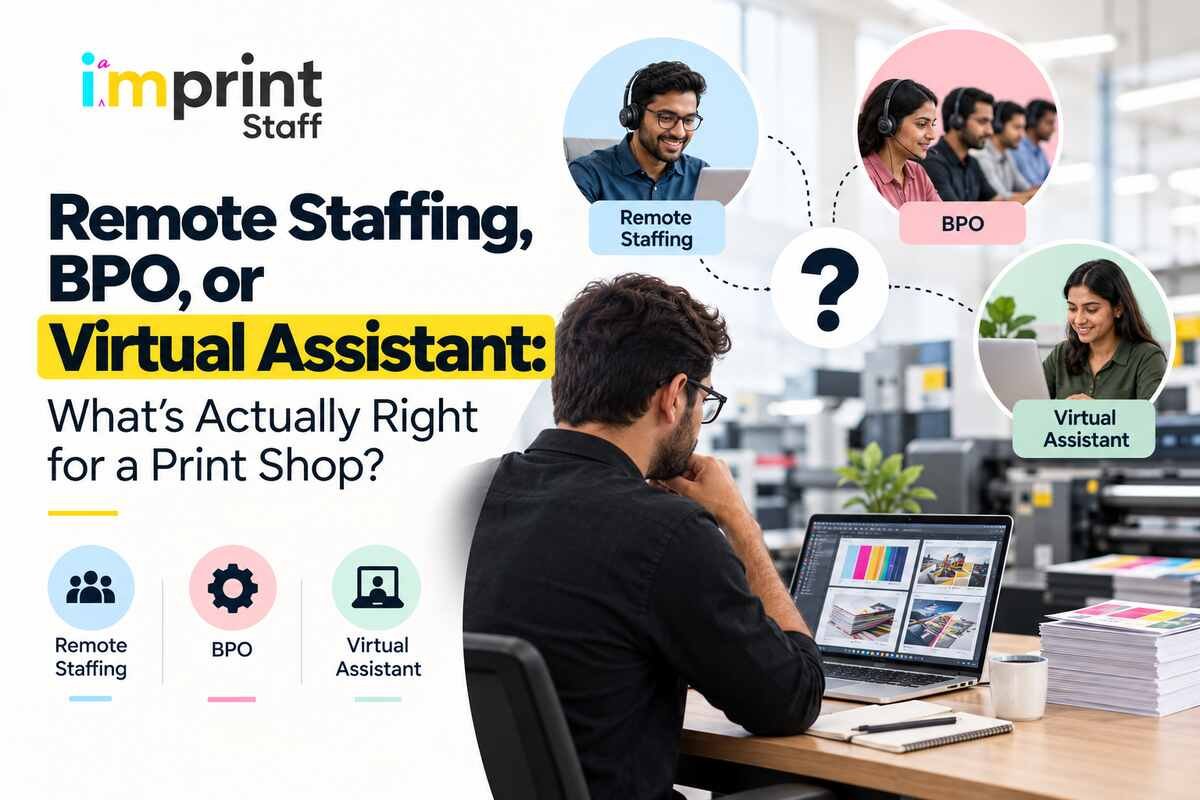

The short answer: a remote staffing agency places a dedicated person who works only for your shop, inside your systems, under your direction. A BPO (business process outsourcing) provider takes over a whole process and delivers an agreed result, managing the people itself. A virtual assistant (VA) is a remote generalist who handles flexible admin tasks, often part-time or shared across clients.
For a print shop, the right choice depends on two things: who should direct the work and how much print knowledge the work needs. Inbox management or appointment scheduling can go to a general VA. Estimating, order entry, prepress and storefront administration usually can’t, because they depend on knowing run charges, substrates, imposition and your MIS.
If you’ve started looking at back-office help and every provider seems to call itself something slightly different, this guide sorts out what each model actually is, how they compare on control, cost and ramp-up, and which kinds of print-shop work fit each one.
What Is Remote Staffing?
Remote staffing is a model where an agency recruits, vets and places a professional who works remotely as a dedicated member of your team. The person works your hours (or an agreed overlap), uses your tools and systems, follows your processes and takes day-to-day direction from you or your managers.
The agency typically handles recruiting and screening, and often the employment administration (payroll, HR, local compliance) and replacement if a placement doesn’t work out. You handle what you’d handle with any employee: training on your specific processes, assigning work and managing performance.
What makes it different: you get a specific person, not a pool of people or a service outcome. That person builds knowledge of your customers, pricing logic and production quirks over time, and that knowledge stays on your account.
Variants you’ll see: “staff augmentation,” “dedicated remote staff,” “offshore staffing” and “virtual employees” all describe versions of the same model. The details to check are whether the person is full-time and dedicated to you, and who employs them.
What Is BPO (Business Process Outsourcing)?
BPO is contracting an outside company to run an entire business process (customer support, claims processing, payroll, collections) and deliver a defined outcome. The BPO provider hires, trains, schedules and manages the people doing the work. You manage the contract, typically through a service level agreement (SLA) that sets targets such as response time, accuracy or volume handled.
What makes it different: you’re buying a result, not a person. The work may be handled by a rotating team, and the provider decides how to staff it.
Where it fits well: high-volume, repeatable processes with clear rules and measurable outputs, such as after-hours phone answering, first-line inquiries or large-scale data entry. BPO is a large, mature industry built around that kind of standardized work.
Where it struggles in print: work that’s full of judgment calls specific to your shop. A BPO agent following a script can log a reorder request. It’s much harder to script whether a customer’s file needs a rebuild, or why a job with 4/1 printing, a soft-touch laminate and a die cut needs a different estimate than last month’s similar-looking one.
What Is a Virtual Assistant?
A virtual assistant is a remote worker, usually a generalist, who handles administrative tasks: email and calendar management, data entry, scheduling, research, simple bookkeeping entries, social media posting or CRM updates. VAs may work as independent freelancers, through a VA platform or through a VA agency, and are often part-time or split across several clients.
What makes it different: flexibility and low commitment. You can start with a few hours a week and a short task list.
Where it fits well: admin work that doesn’t depend on industry knowledge and where mistakes are cheap to catch.
Where it struggles in print: “virtual assistant for small business” covers a huge range of skill levels. A general VA can enter an order if every field is spelled out, but usually won’t spot that the quantity breaks look wrong, that the job ticket is missing a finishing spec, or that the file attached won’t print at the requested size. Some VA providers now advertise print or promo specialization; if you go that route, test for it rather than assuming it.
How Remote Staffing, BPO and Virtual Assistants Compare
| Remote staffing (dedicated) | BPO | Virtual assistant | |
| What you’re buying | A specific person on your team | A process outcome under an SLA | Flexible task help |
| Who directs daily work | You | The provider | You (loosely) |
| Dedicated to your shop? | Yes, typically full-time | Usually not; pooled or rotating team | Often part-time or shared across clients |
| Works inside your MIS/ERP? | Yes, as part of the role | Sometimes; often uses the provider’s tools | Sometimes, for basic entry |
| Best for | Ongoing roles needing judgment and context (estimating, order entry, prepress, storefront admin, AP/AR) | High-volume, rules-based processes with measurable outputs | Low-risk admin and ad hoc tasks |
| Knowledge retention | High; builds on your account over time | Sits with the provider’s process documents | Varies; depends on the individual staying |
| Your management effort | Similar to managing an employee | Managing a contract and SLA reporting | Light, but you define every task |
| Typical pricing shape | Monthly rate per dedicated role | Per transaction, per hour, or per seat against an SLA | Hourly or block-of-hours |
| Scales by | Adding roles or people | Adjusting volume in the contract | Adding hours |
None of these is “better” in general. They solve different problems. The mistake is buying one model for work that needs another.
The Two Questions That Decide It for a Print Shop
Most comparison articles stop at the table. For a print shop, two questions sort the decision faster.
1. Who should direct the work: you, or the vendor?
If the work changes daily based on your customers, your production schedule and your priorities, such as rush jobs jumping the queue, a key account’s reorder or a vendor delay, you need someone who takes direction from you. That points to remote staffing (or, for light tasks, a VA).
If the work is stable, repeatable and measurable enough to hand off with a scorecard, a vendor can direct it. That’s where BPO fits.
2. How much print knowledge does the work need?
Some tasks need almost none: scheduling, inbox triage, updating a contact list. Others are mostly print knowledge: pricing a job with multiple finishing steps, checking whether a file will print correctly, entering a promo order with sizes, colors and imprint locations, or keeping a corporate storefront’s pricing rules accurate.
The more print knowledge a task needs, the more a generalist’s ramp-up costs you, in training time, in your own time spent checking their work, and in reprints when something slips through. That’s the case for print-fluent staffing: people who already understand imposition, substrates, run charges, proofing and common print MIS/ERP workflows, so the learning curve is your shop’s specific process, not the industry.
Put the two questions together and the answer for most print work becomes clear:
| Low print knowledge needed | High print knowledge needed | |
| You direct the work | Virtual assistant | Print-fluent remote staff |
| Vendor directs the work | General BPO | Specialized print outsourcing (rare; most print processes resist full handoff) |
Which Print-Shop Tasks Fit Which Model?
Here’s how common back-office work in print, promo, sign and apparel businesses maps to each model. These are typical fits, not rules; a well-documented process can move a task left or right.
| Task | Usually fits | Why |
| Email/calendar management, scheduling, general admin | Virtual assistant | Low print knowledge; easy to check |
| After-hours phone answering or basic order-status inquiries | BPO or VA | Scriptable, measurable, high volume |
| Order entry into your MIS | Print-fluent remote staff | Needs to catch missing specs, wrong quantities and variant errors before they reach production |
| Estimating and quoting | Print-fluent remote staff | Depends on your pricing logic, run charges, substrates and finishing, and on judgment |
| Prepress (preflight, file prep, color, proofing, imposition) | Print-fluent remote staff | Technical print skill; errors become reprints |
| Web-to-print storefront administration | Print-fluent remote staff | Pricing rules, product templates and order routing are print-specific |
| Key account management | Print-fluent remote staff | Relationship continuity and knowledge of the customer’s jobs |
| Bookkeeping, AP/AR, payroll | Dedicated remote staff with print-shop familiarity (or a specialist firm) | Process is standard, but job costing and print-specific billing patterns matter |
| Social media posting, light research | Virtual assistant | Low risk, flexible hours |
For a deeper look at the operational roles in this table, see our guides to:
print operations support, what a prepress team actually does and outsourced bookkeeping for print shops.
Why Industry-Specific Staffing Matters for a Print Shop
The difference between generic and print-fluent help shows up in the details:
- A generic VA enters an order exactly as written. A print-fluent order entry specialist notices that the stock listed won’t run on the press specified, or that a promo order is missing an imprint location.
- A generic BPO estimator follows a pricing sheet. A print-fluent estimator knows when a job’s finishing, makeready or substrate makes the standard sheet wrong.
- A generic designer makes a layout look right on screen. A print-fluent prepress designer makes sure it prints right, with correct bleed, resolution and color for the device and material.
Each catch is small. Across hundreds of orders a month, those catches decide whether outsourcing saves time or creates rework. That’s why the hourly rate is a poor way to compare options. A cheaper generalist who needs constant checking, or who lets errors reach production, often costs more than a specialist who doesn’t.
Common Mistakes When Choosing Back-Office Help
- Choosing on hourly rate alone. Compare the full cost: your time spent training and checking, error and reprint rates, and how long until the person works independently.
- Handing judgment-heavy work to a script. BPO works well for rules-based processes. Estimating and prepress are mostly exceptions to the rules.
- Starting with the hardest role and no documentation. Whatever model you choose, write down how your shop handles its most common jobs first. A good remote hire will learn faster, and a weak one will be obvious sooner.
- Not giving access to the real systems. Remote help that can’t work in your MIS/ERP, file workflow or storefront platform ends up re-keying information and creating a second source of truth.
- Skipping the security conversation. Ask how customer files, pricing and financial data are protected: individual logins, access you can revoke, confidentiality agreements, and how devices and networks are secured. Ask any provider, in any model.
- Treating it as all-or-nothing. Many shops use a VA for admin and dedicated print-fluent staff for production-side roles. Mixing models is normal.
How to Decide: A Quick Checklist
Work through these for each role or task you’re considering handing off:
- Is it ongoing, or a short project? Ongoing points to remote staffing or a VA; a defined project may suit a freelancer or BPO.
- Does it change daily based on your priorities? If yes, you need someone you direct.
- Would a mistake reach a customer or the press? If yes, print knowledge matters more than price.
- Does it happen inside your MIS/ERP, file workflow or storefront? If yes, the person needs to work in those systems, not around them.
- Can you measure it with a simple scorecard? If yes, BPO is a realistic option.
- Do you want the knowledge to stay with your account? If yes, choose a dedicated model over a pooled one.
Frequently Asked Questions
What is remote staffing?
Remote staffing is a model where an agency recruits and places a dedicated professional who works remotely as part of your team, inside your systems and under your direction. The agency typically handles recruiting and often employment administration; you handle training on your processes and daily management.
How is remote staffing different from BPO?
With remote staffing you get a specific, dedicated person you direct. With BPO you hand a whole process to a provider that manages its own staff and delivers results against an SLA. Remote staffing fits judgment-heavy, changing work; BPO fits high-volume, rules-based work.
Is a virtual assistant the same as outsourced staff? Not usually. A virtual assistant is typically a generalist handling flexible admin tasks, often part-time or shared across clients. Dedicated outsourced staff work full-time for one business in a specific role, such as order entry, estimating or prepress, and build knowledge of that business over time.
What does a remote staffing agency do?
A remote staffing agency sources, screens and places remote professionals with client businesses, and usually manages employment administration and replacement if a placement doesn’t work out. Specialized agencies focus on one industry or role type, so candidates arrive with relevant skills.
Why does industry-specific staffing matter for a print shop?
Much of a print shop’s back office (estimating, order entry, prepress, storefront administration) depends on knowing print terminology, pricing logic, file requirements and MIS/ERP workflows. Print-fluent staff need training only on your shop’s processes, not the industry, which shortens ramp-up and reduces errors that become reprints.
Can I use more than one model?
Yes. Many shops use a virtual assistant for general admin, BPO for overflow phone or inquiry handling, and dedicated print-fluent staff for production-side roles. Match each model to the work it suits.
The Bottom Line
Remote staffing, BPO and virtual assistants aren’t competing versions of the same thing. A VA handles flexible, low-risk admin. A BPO runs a standardized process to a scorecard. A remote staffing agency gives you a dedicated person who works as part of your team. For most print shops, the roles that hurt most when they’re understaffed (estimating, order entry, prepress, storefront administration, key accounts) need both your direction and real print knowledge. That combination is what print-fluent remote staffing exists for.
Imprint Staff is a remote staffing partner built exclusively for the print and promotional products industry, placing print-fluent professionals directly into your existing workflow and systems. Browse the roles we staff across print operations, prepress, customer experience and finance, or see how Imprint Staff works before you decide on your shop’s first hire.